
What factors should influence your decision when choosing between reconditioned and new mobility beds and bath lifts for long-term value and reliability?
When choosing between a new and reconditioned mobility bed or bath lift, compare the total cost, expected reliability, warranty, safety condition, suitability for the user and availability of servicing and replacement parts. A new item offers the latest specification and a full service history from manufacture, while a professionally reconditioned model can provide good long-term value when it has been thoroughly inspected, tested and matched to your needs.
The best choice between a new and reconditioned mobility bed or bath lift depends on more than the purchase price. Compare the total cost of ownership, the equipment’s condition, suitability for the user, warranty protection, availability of parts and the quality of the assessment, installation and aftercare. A new product offers unused components and the manufacturer’s current specification, while a professionally reconditioned product can offer strong long-term value when it has been inspected, tested, safely restored and matched correctly to the user and their home.
Start with the user’s needs and the environment
Suitability should be considered before age or condition. A mobility bed must support the user’s required sleeping position, transfers and day-to-day routines. Consider the bed’s height range, back and leg adjustment, mattress compatibility, side-rail arrangements, handset controls, clearance around the bed and the available space for carers to work safely. Check the safe working load, including the user, mattress and any equipment placed on the bed, against the manufacturer’s instructions.
For a bath lift, assess the shape and dimensions of the bath, the user’s ability to transfer, leg strength, balance, reach and grip. The user must be able to operate the controls or have appropriate assistance. A lift that does not lower the user sufficiently, provide adequate back support or leave enough room for safe transfer may be unsuitable, even if it is in excellent condition. A home assessment is particularly important where there are narrow access routes, uneven floors, limited bathroom space or other mobility equipment in use.
Understand what you are paying for
The purchase price is only one part of long-term value. Ask whether the quoted cost includes delivery, installation, demonstration, removal of an old product, initial safety checks and follow-up support. Also consider likely costs for servicing, batteries, handset replacements, covers, mattresses, chargers and other wear items.
A new mobility bed or bath lift may cost more initially, but it normally comes with a manufacturer’s warranty and current technical support. A reconditioned model may reduce the initial outlay, particularly where the required specification is straightforward. Its value depends on how thoroughly it has been restored and how much useful service life remains. A low price is not good value if the equipment needs early repairs, lacks parts or is difficult to support.
Ask for a clear explanation of what is included and whether any warranty covers labour as well as parts. Check its duration, exclusions, response arrangements and whether servicing must be completed by an approved or suitably competent provider. Warranty terms for reconditioned equipment can differ from those for new products, so they should be understood before ordering.
Check the reconditioning process
“Reconditioned” should mean more than cleaned or cosmetically improved. Ask whether the equipment has been:
- identified by make, model and serial number;
- examined for structural damage, corrosion, wear and missing components;
- cleaned using methods suitable for the materials and intended use;
- tested through its full range of movement and operating functions;
- checked for safe operation of controls, batteries, chargers and actuators;
- inspected for damaged cables, plugs, handsets, covers and connection points;
- tested for relevant safety features, such as emergency lowering or stop functions where fitted;
- provided with suitable instructions and any necessary accessories; and
- recorded as having passed the supplier’s inspection before installation.
For a mobility bed, particular attention should be given to the lifting mechanism, castors, brakes, side rails, mattress platform, handset and pinch points. For a bath lift, check the seat and backrest, side flaps, covers, battery unit, charger, suction or fixing system and emergency lowering function. The precise checks will depend on the model, so the supplier should be able to explain the inspection procedure rather than give a general assurance.
Compare reliability and future support
New equipment is not automatically more reliable in every situation, and reconditioned equipment is not automatically less reliable. Reliability depends on the design, the operating environment, correct installation, regular maintenance and the condition of individual components. A reconditioned product with a documented inspection and available replacement parts may be a more dependable choice than an unsuitable new product.
Before choosing either option, ask how long parts are expected to remain available and whether the supplier can service the exact model. This is important for older reconditioned equipment, discontinued models and products with proprietary batteries or control systems. Confirm who to contact if the equipment stops working, how urgent faults are handled and whether loan equipment or alternative arrangements may be available if a repair cannot be completed promptly.
Regular servicing helps identify wear before it affects safe operation. It does not remove the need for sensible daily checks. Users or carers should report unusual noise, jerky movement, unexpected stops, damaged cables, battery problems, loss of power, sticking controls or changes in stability. Do not continue using equipment that appears unsafe until it has been assessed by a suitably qualified person.
Consider safety and documentation
Ask for the operating instructions, maintenance information, warranty details and any available conformity or safety documentation. The product should be supplied with clear information about its intended use, safe working load, charging, cleaning, emergency procedures and restrictions. The installer should explain these points in a way the user and carer can follow.
Check that the equipment is suitable for the user’s weight, height, posture and transfer method, and that carers can reach the controls and release points. A bed should not create avoidable entrapment or trip risks, and a bath lift should not make transferring in or out more difficult. Keep cables, chargers and handset leads positioned as instructed, and do not modify side rails, controls or safety mechanisms.
Where the equipment will be used by someone with limited capacity, reduced sensation, dementia, visual impairment or a tendency to move unexpectedly, include the appropriate carer or occupational therapist in the decision. The safest option may involve additional support or a different type of equipment rather than simply choosing a new model.
Balance specification against practical value
A new model may be preferable when the user needs a current feature, a particular size or configuration, extended warranty protection, or a product that will be used intensively for many years. It may also be the more practical option where future compatibility with accessories and servicing systems is important.
A reconditioned model may be appropriate when it meets the user’s requirements without unnecessary features, the condition is documented, the warranty is acceptable and ongoing support is available. It can be especially sensible where a proven, familiar design is preferred, provided the equipment is not too old or difficult to maintain.
Use a structured comparison before deciding
- Record the user’s mobility, transfer and care requirements.
- Measure the bedroom or bathroom and confirm access for delivery and installation.
- Compare the complete installed cost, not just the equipment price.
- Ask for the model, age, condition and inspection details of any reconditioned item.
- Check the warranty, expected parts availability and servicing arrangements.
- Confirm the safe working load, controls, emergency functions and required accessories.
- Make sure the user and carers receive an installation demonstration and instructions.
- Agree how faults, servicing and replacement batteries or other wear items will be handled.
In practice, the strongest long-term choice is the option that fits the user and property safely, has transparent condition and warranty information, and can be maintained throughout its expected working life. A new mobility bed or bath lift may provide the clearest route to current features and manufacturer support; a professionally reconditioned model may provide better value where its inspection, remaining service life and aftercare are properly established.
A reconditioned mobility bed or bath lift is only a reliable long-term option when its condition has been assessed, tested and documented by a competent provider. Cosmetic cleaning alone does not confirm that lifting mechanisms, batteries, controls, safety features or fixing systems remain safe to use.
Before choosing reconditioned equipment, ask for confirmation that it has been:
- identified by its make, model and serial number;
- checked for structural damage, corrosion and worn components;
- tested through its full range of movement;
- inspected for safe operation of controls, chargers, batteries and cables; and
- supplied with suitable instructions, accessories and warranty information.
Also confirm that replacement parts and servicing remain available for the specific model. A professionally inspected item with clear aftercare can offer better value than a cheaper product with an unknown history, while a new model may be preferable where current features, intensive use or longer manufacturer support are important.
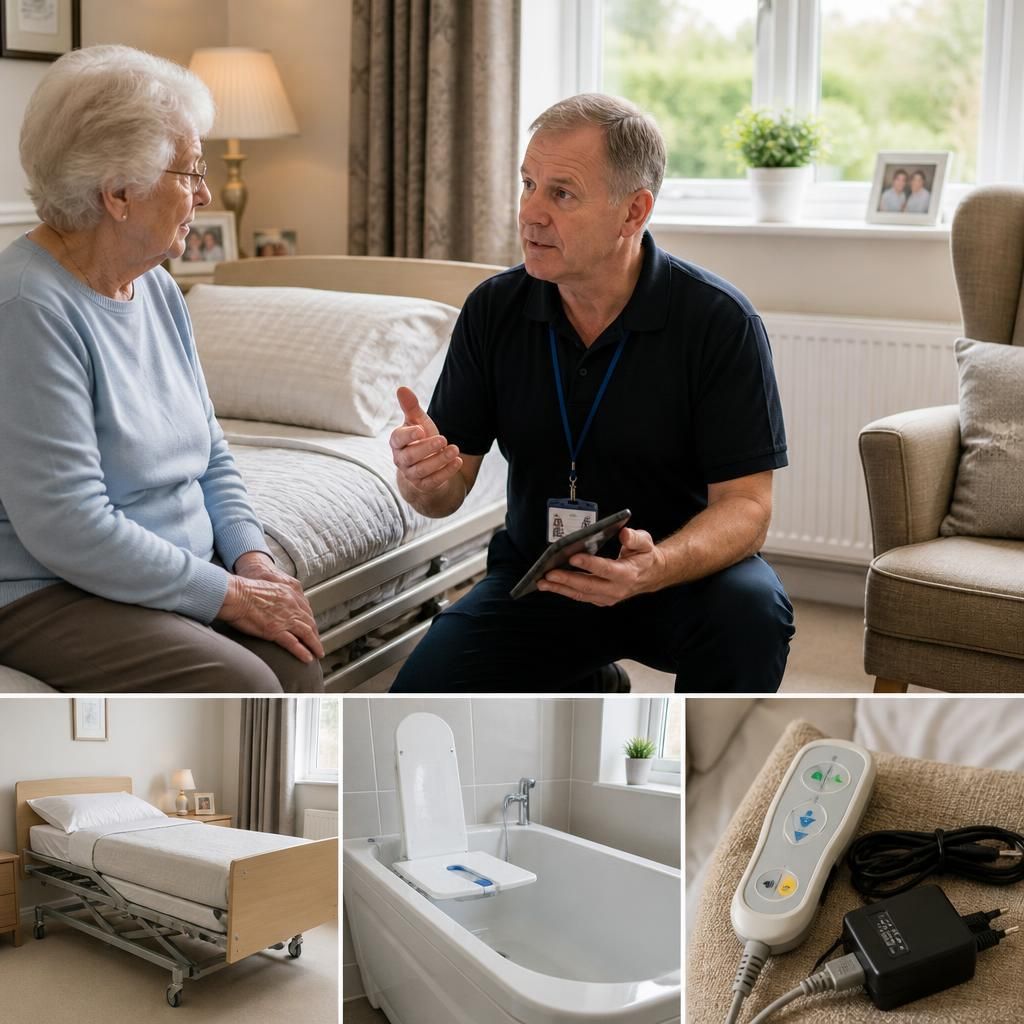
Arrange expert advice on your mobility bed or bath lift
If you are unsure whether a new or reconditioned mobility bed or bath lift is right for your needs, arrange expert advice on the equipment’s suitability, condition, warranty and future servicing requirements. We can help you compare the options before you decide.