
What are the necessary safety considerations and certifications to look for when selecting a servicing provider for mobility beds and bath lifts?
Choose a servicing provider that uses trained, competent engineers, follows the manufacturer’s instructions, completes documented mechanical and electrical safety checks, and provides clear service records. Check that the provider has appropriate public liability and professional insurance, understands relevant UK safety requirements such as electrical safety and, where applicable, LOLER or PUWER duties, and can verify that replacement parts and the equipment meet the applicable UKCA or CE requirements.
A suitable servicing provider should use competent, suitably trained engineers who follow the manufacturer’s instructions, complete documented mechanical and electrical safety checks, and issue a clear service record. The provider should also understand the UK requirements that may apply to the particular equipment and installation, including electrical safety, the Provision and Use of Work Equipment Regulations (PUWER), the Lifting Operations and Lifting Equipment Regulations (LOLER) where relevant, and product conformity requirements such as UKCA or CE marking.
Certification alone is not a guarantee of safe work. The most important evidence is a combination of relevant training, practical experience with mobility beds and bath lifts, appropriate inspection procedures, traceable records, suitable insurance and a willingness to explain any safety issue found.
Check the engineer’s competence and product experience
Ask whether the engineer has been trained to service the type and model of mobility bed or bath lift you own. A competent engineer should be able to identify the equipment’s controls, actuators, batteries, charging system, emergency lowering or raising functions, side rails, handset, transfer aids and other model-specific safety features.
- Training should cover the manufacturer’s servicing and adjustment procedures, not just general electrical or mechanical work.
- The engineer should know the safe working limits and intended use of the equipment.
- They should understand how to recognise wear, damage, fluid ingress, cable deterioration, trapped-patient risks and unsafe modifications.
- They should be able to explain when a part must be replaced rather than repaired or adjusted.
It is reasonable to ask for details of relevant technical training or manufacturer-authorised training where available. Not every capable independent engineer will hold a certificate for every model, but the provider should be able to demonstrate relevant competence and explain how it keeps that knowledge current.
Ask what safety checks are included
A proper service should be more than cleaning the equipment or confirming that it moves. The provider should use a written checklist appropriate to the model and record the results. Checks commonly include:
- the condition and security of the frame, mattress platform, bath lift seat, backrest, side rails and other structural components;
- actuators, motors, drive mechanisms, hinges, pivots and moving parts for abnormal noise, looseness, damage or excessive wear;
- handsets, control panels, emergency stop controls and any wired or wireless controls;
- limit switches, anti-entrapment features, safety edges, sensors and emergency lowering or raising systems;
- power leads, plugs, chargers, batteries, connectors and cable routing, including signs of overheating or damage;
- the operation of brakes, castors, locking systems, transfer supports and height or position adjustments;
- bath lift belts, flaps, side supports, suction components and transfer surfaces where fitted;
- the equipment’s stability, safe clearances and positioning in the room;
- cleanliness and contamination risks, particularly around bath lifts and equipment used in personal care; and
- the safe working load, user positioning and any conditions that could cause the equipment to be used incorrectly.
Electrical checks should be completed with suitable test equipment and in accordance with the manufacturer’s instructions. Ask whether the service includes a visual inspection, functional test and, where appropriate, electrical safety testing. A provider should not rely on a generic pass or fail label without explaining what was tested and whether any limitations apply.
Understand the relevant UK regulations
The exact legal duties depend on the equipment, its use and who owns or operates it. A domestic user will not necessarily have the same obligations as a care home, hospital, landlord or other organisation, but a professional servicing provider should understand the distinction.
- PUWER: The Provision and Use of Work Equipment Regulations can apply where equipment is provided for use at work. They concern the suitability, maintenance, inspection and safe use of work equipment. A provider servicing equipment in a commercial or care setting should be able to explain how its inspection process supports the owner’s duties.
- LOLER: The Lifting Operations and Lifting Equipment Regulations may apply to equipment used for lifting people or loads, depending on its design and use. Some mobility beds, bath lifts and associated lifting equipment may fall within the scope of lifting-equipment duties, while others may not. The provider should assess this rather than automatically claiming that LOLER applies to every product.
- Electrical safety: The provider should follow safe systems for mains-powered and battery-powered equipment, inspect cables and plugs, and use appropriate electrical testing where required. Portable appliance testing by itself is not a complete service and does not replace mechanical or functional checks.
- Product safety and conformity: Equipment and replacement components should be suitable for the intended product and market. UKCA or CE marking may be relevant to the original product or replacement parts, but a mark is not evidence that a particular service visit has been completed safely. Ask the provider to use compatible, traceable parts and retain relevant documentation.
For equipment supplied or used as a medical device, the provider should also understand the manufacturer’s instructions and the applicable medical-device requirements. If a safety-related fault is suspected, the equipment should be taken out of use until it has been assessed rather than simply reset or returned to service.
Request clear service and inspection records
After servicing, you should receive a written report or service certificate identifying the equipment, its model or serial details where available, the date of inspection, the work completed, tests carried out, parts fitted and any defects found. The record should state whether the equipment was left safe for use, whether use is subject to restrictions, or whether further work is required.
A useful report should also include:
- the engineer’s name or identification;
- the provider’s business details;
- test results or measured values where these are relevant;
- the next recommended service or inspection date;
- details of parts that were replaced or adjusted; and
- clear advice if the user, carer or household needs to change how the equipment is operated.
Keep the report with the equipment’s instructions. For equipment used by several people or in a care environment, accurate records help demonstrate that inspections were planned and that reported faults were dealt with.
Check insurance and business safeguards
Ask whether the provider holds appropriate public liability insurance and, where advice, design or specification forms part of the service, professional indemnity cover. Employers’ liability insurance is also relevant where the provider employs staff. Insurance does not prove technical competence, but a reputable provider should be willing to confirm the cover it holds and any limits that may affect the work.
Where an engineer will work in a vulnerable person’s home, consider whether the provider has suitable safeguarding, lone-working and data-protection procedures. These are not substitutes for engineering certification, but they are important practical safeguards when servicing equipment used for personal care or transfers.
Confirm how faults, parts and urgent risks are handled
Before booking, ask what happens if the equipment fails inspection. The provider should explain how it identifies an unsafe condition, whether it will label or isolate the equipment, and how it will obtain compatible parts. It should not disable a safety feature, make an unapproved modification or fit an unsuitable substitute simply to restore movement.
For a mobility bed, particular attention may be needed if the fault affects height adjustment, profiling, side rails, castors, brakes or entrapment clearances. For a bath lift, the service should address lowering and raising, battery condition, charger operation, stability, seat or belt security and safe transfer. If the equipment is wet, damaged, unstable, producing a burning smell or moving unexpectedly, stop using it and seek professional advice.
Questions to ask before selecting a provider
- Are your engineers trained and experienced with this make and model?
- Which mechanical, electrical and functional checks are included?
- Do you follow the manufacturer’s servicing instructions?
- Could PUWER or LOLER apply to this equipment or its setting, and how do you assess that?
- Will I receive a written report showing the tests, findings and any restrictions?
- Are replacement parts compatible and traceable, and will you explain any non-original part used?
- What insurance do you hold, and what happens if the equipment is found unsafe?
Be cautious if a provider cannot identify the equipment being serviced, offers only a generic certificate, refuses to explain its checks, recommends a repair without investigating the cause, or treats a moving piece of equipment as safe without checking its controls, structure and electrical supply. Choosing a provider that can show competence, follow documented procedures and communicate findings clearly gives you stronger evidence that the mobility bed or bath lift has been assessed responsibly.
When choosing a servicing provider for a mobility bed or bath lift, look for evidence of competent inspection rather than relying on a certificate alone. The engineer should understand the equipment’s make and model, follow the manufacturer’s servicing instructions, and check its mechanical, electrical and safety functions.
After the visit, request a written service record identifying the equipment, inspection date, checks completed, defects found, parts fitted and whether it was left safe for use. The provider should also explain any restrictions or further repairs required. Relevant training, suitable insurance, compatible replacement parts and an understanding of applicable requirements such as PUWER or LOLER, where relevant, provide additional assurance that the service has been carried out responsibly.
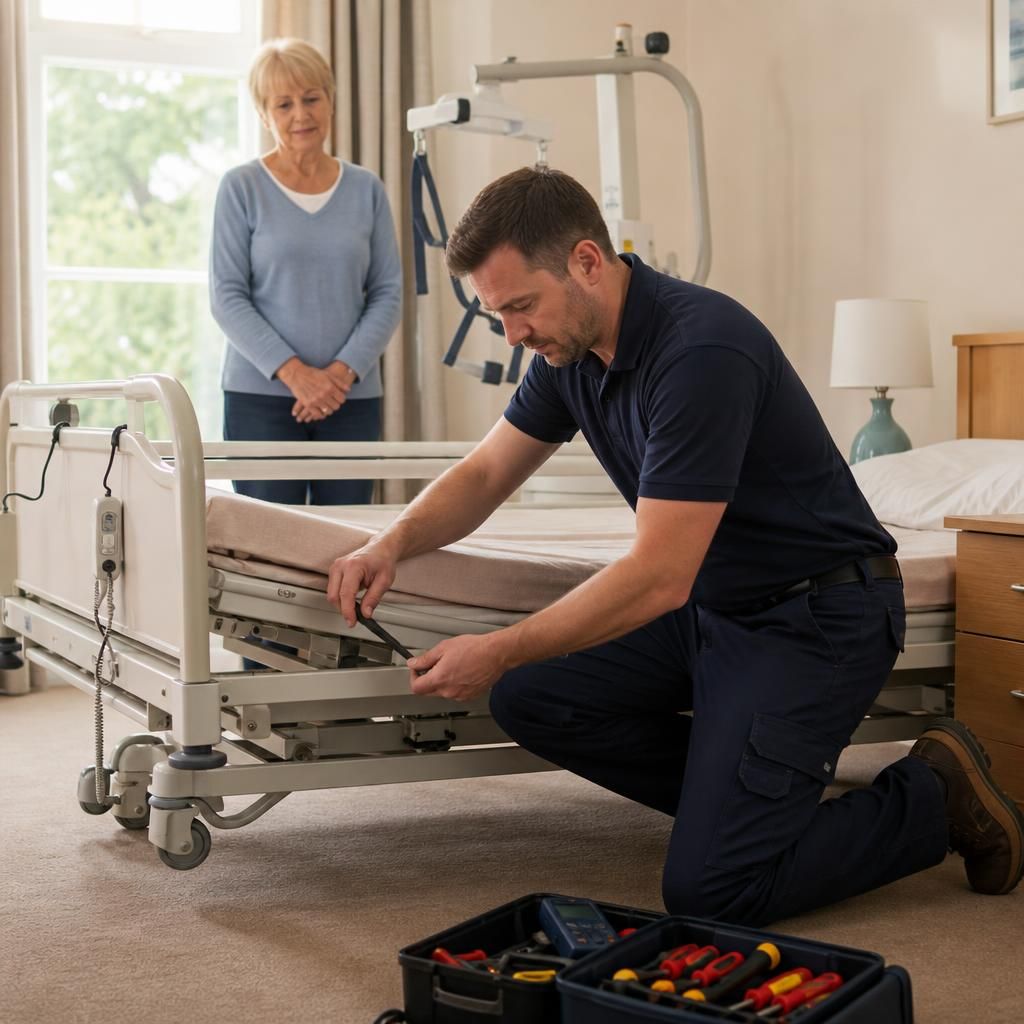
Book a Safety-Focused Mobility Bed or Bath Lift Service
Book a safety-focused mobility bed or bath lift service with a competent engineer who can complete the appropriate mechanical, electrical and functional checks and provide a clear written service record.