
How often should a stairlift be serviced to maintain optimal performance?
A stairlift should usually be professionally serviced at least once a year, following the manufacturer’s maintenance guidance. Older, heavily used or outdoor stairlifts may need more frequent checks, while any unusual noise, jerky movement, charging problem or fault warning should be assessed without waiting for the next scheduled service.
A stairlift should normally be professionally serviced at least once a year, in line with the manufacturer’s instructions and any maintenance agreement. Older stairlifts, lifts used several times each day, and outdoor models may require more frequent attention. You should also arrange an inspection promptly if the lift develops unusual noises, jerky movement, charging problems, repeated fault warnings or any other change in performance.
Regular servicing is important because a stairlift is a mechanical and electrical device used to carry a person between floors. A service can identify wear or developing faults before they affect reliability, and helps confirm that the lift’s safety systems, drive mechanism, seat and charging equipment are working correctly. It is not a substitute for reporting a problem as soon as it appears.
When to arrange a service
- At least annually: This is a suitable routine interval for many domestic stairlifts, unless the manufacturer or service provider recommends otherwise.
- More often where use is heavy: Frequent daily journeys place greater demand on the motor, drive components, batteries and track. A servicing plan may therefore be appropriate for a lift used extensively.
- After a long period out of use: Batteries can discharge and contacts or moving parts may require inspection before the stairlift is used regularly again.
- For outdoor stairlifts: Exposure to rain, damp, dirt, temperature changes and sunlight can increase the need for inspection and cleaning. Follow the recommended outdoor servicing schedule rather than relying solely on an indoor lift interval.
- After a significant change: Alterations to the staircase, a move to a new property, water ingress or impact damage should be assessed by a qualified engineer before normal use continues.
Your manufacturer’s guidance, warranty terms and service contract take priority over a general timetable. Some agreements specify a service interval or particular conditions that must be met to keep cover valid. If the stairlift is reconditioned or has been installed for some time, ask for its service history and the engineer’s recommendation for future checks.
What a professional service normally includes
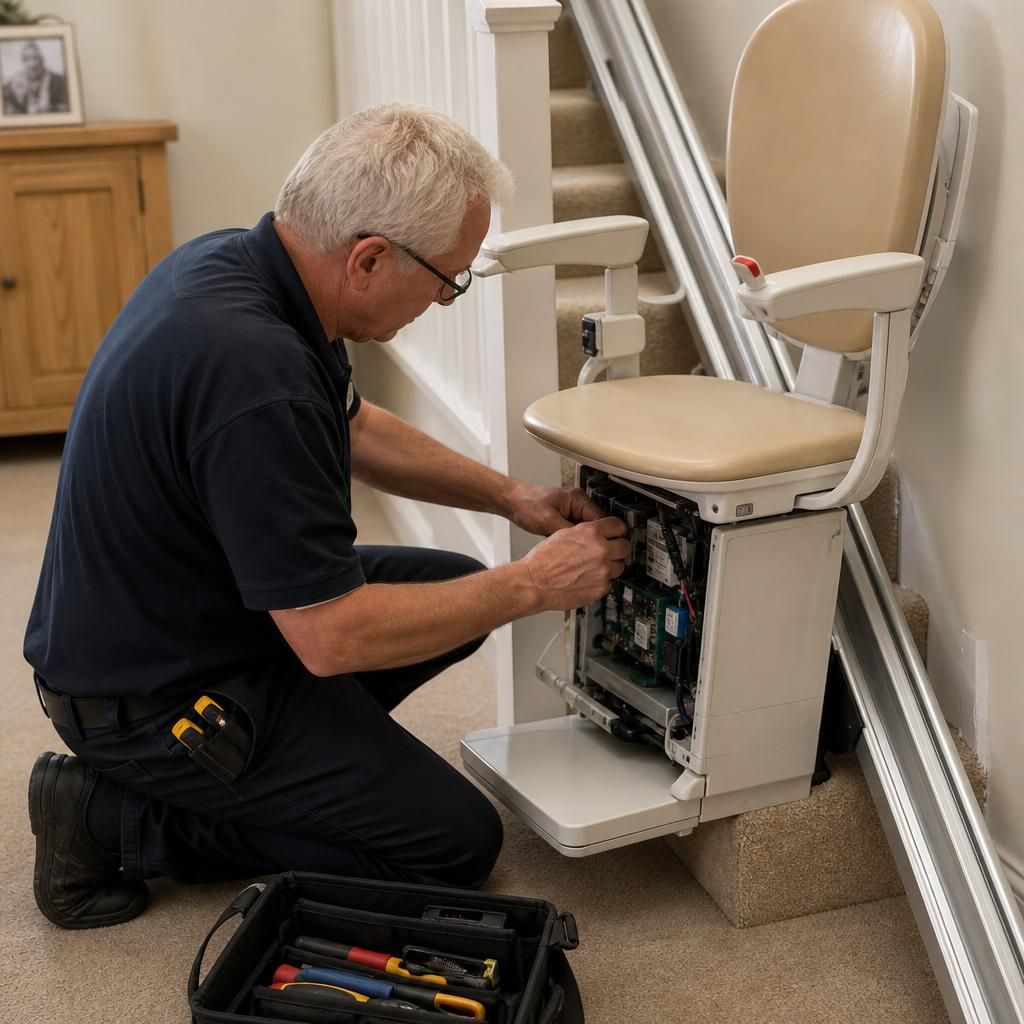
The engineer should assess the stairlift as a complete system rather than simply lubricating the track. Depending on the model, the inspection may include the following:
- Checking the carriage, motor, drive system, track and mechanical fixings for wear, damage or looseness.
- Testing the seat, swivel mechanism, armrests, footrest, safety belt and any obstruction or safety sensors.
- Checking the controls, remote controls, call/send switches and display or fault indicators.
- Testing the batteries, charging points and electrical connections, including whether the lift parks correctly at its charging locations.
- Checking start and stop operation, travel speed, braking and movement on the full staircase.
- Cleaning and lubricating suitable components in accordance with the manufacturer’s instructions.
- Identifying parts that may need monitoring, adjustment or replacement before the next scheduled service.
Not every component should be lubricated by the user. Incorrect products or lubrication in the wrong location can attract dirt, affect sensors or interfere with the drive system. An engineer should also explain any work completed and record recommendations for follow-up repairs or parts.
Signs that you should not wait for the next service
Contact us or your service provider for advice if the stairlift makes grinding, clicking or squealing noises; starts or stops abruptly; travels unevenly; struggles on part of the staircase; fails to charge; loses power; displays a fault warning; or stops at an unexpected point. A seat that does not swivel or lock correctly, a loose armrest or footrest, a damaged safety belt, or a sensor that does not operate properly should also be treated as a safety concern.
If the stairlift stops, switch it off if this can be done safely, keep the user seated and follow the operating and emergency guidance supplied with the lift. Do not attempt to bypass a safety switch, dismantle the carriage or use improvised parts. If there is smoke, a burning smell, visible electrical damage or water around electrical components, stop using the lift and seek urgent professional advice.
Checks you can make between services
Routine user checks can help identify problems early, but they do not replace professional servicing. Keep the track and landing areas clear, check that the lift reaches its charging position, and make sure the safety belt, controls and swivel seat operate as expected. Wipe away surface dirt using the method recommended for your model, and keep the lift dry unless it is designed for outdoor use. Do not exceed the stated user weight, carry items that could obstruct the footrest or sensors, or allow objects to catch in the track.
Report small changes rather than waiting for them to become a breakdown. A written note of the symptom, when it occurs, any displayed fault code and whether the batteries were charging can help the engineer diagnose the problem efficiently.
In practical terms, an annual professional service is the usual minimum for a domestic stairlift, with the interval adjusted for the model, age, environment and intensity of use. Keeping scheduled services alongside prompt reporting of faults and sensible daily checks gives the best opportunity of maintaining safe, dependable performance over the life of the lift.
A stairlift should usually receive a professional service at least once a year, unless the manufacturer or service agreement specifies a different interval. Regular servicing allows an engineer to assess the drive system, track, batteries, charging points, controls and safety features before wear develops into a breakdown.
More frequent servicing may be appropriate for an older stairlift, a lift used heavily each day or an outdoor model exposed to damp, dirt and changing temperatures. Do not wait for the scheduled appointment if you notice jerky movement, unusual noise, charging difficulties, fault warnings or a change in braking. These symptoms should be reported promptly so the stairlift can be checked safely.
Arrange Your Stairlift Service
Arrange your stairlift service with Independent Stairlifts to keep its safety systems, batteries and drive components working reliably. Contact us to discuss the appropriate servicing schedule for your stairlift.