
What procedures are involved in an Acorn stairlift service and repair?
An Acorn stairlift service and repair typically includes a full inspection of the rail, motor, batteries, controls, seat and safety systems, followed by cleaning, adjustments and operational testing. If a fault is found, the engineer will diagnose the cause, explain the required repair and replace worn or failed parts where necessary.
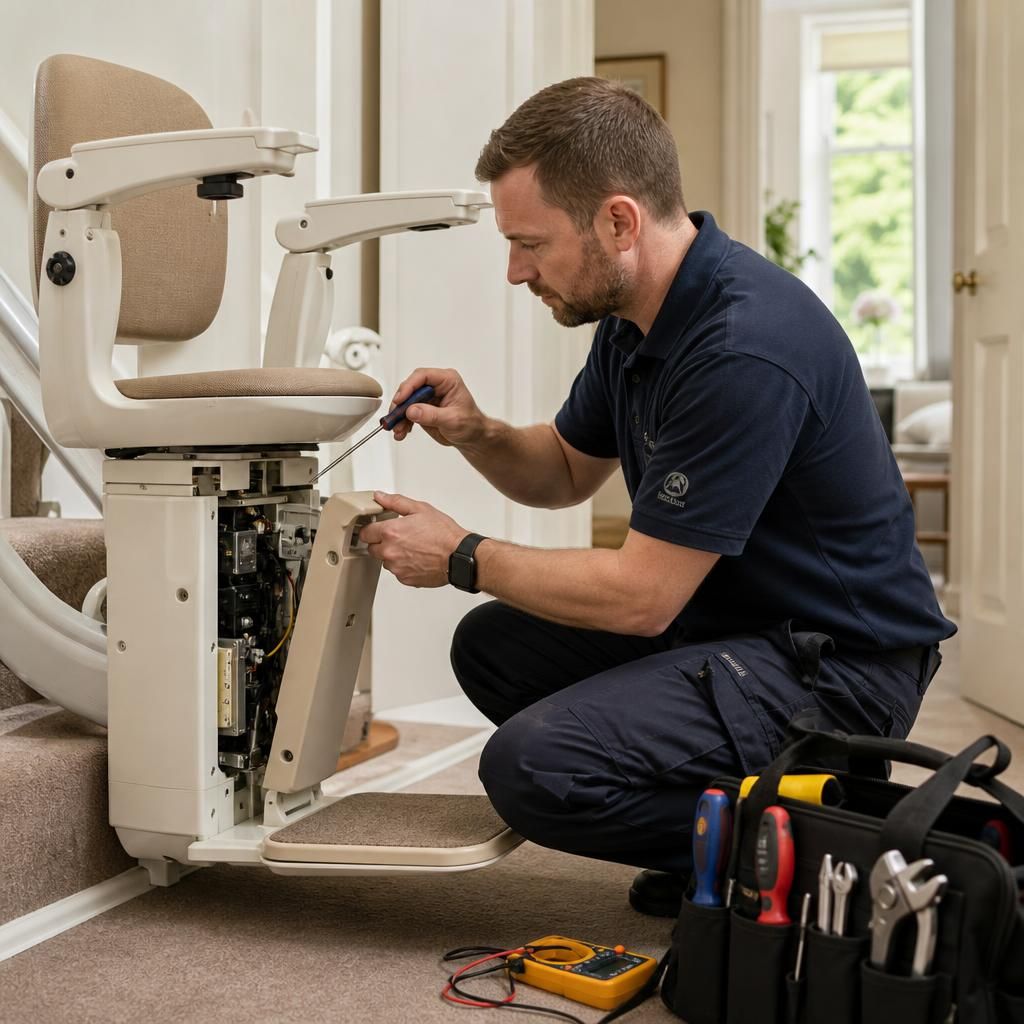
An Acorn stairlift service and repair normally involves a structured inspection of the lift, followed by testing, cleaning, adjustment and, where needed, replacement of faulty or worn components. The engineer will assess the stairlift’s mechanical and electrical systems, identify the cause of any fault and explain which repairs are necessary before work is completed.
Initial assessment and safety checks
The service begins with a discussion about the stairlift’s performance. You may be asked when the problem started, whether it occurs consistently and whether any warning lights, sounds or error indications have appeared. This information can help the engineer focus on the affected system.
The stairlift is then inspected for obvious safety issues, damage, loose fittings or signs of wear. The engineer will usually check that the seat, armrests, footrest, seat belt and swivel mechanism operate correctly. They may also confirm that the stairlift is securely fitted and that it does not obstruct the staircase or catch on nearby fixtures.
Rail, carriage and mechanical inspection
The rail is checked for secure fixings, dirt, obstructions and signs of damage. The engineer will examine the carriage that travels along the rail, including its rollers, drive mechanism and other moving parts. Any unusual noise, hesitation, juddering or uneven movement can indicate that cleaning, lubrication, adjustment or a replacement component is required.
Where appropriate, the engineer will clean accessible parts of the rail and carriage and apply suitable lubrication to components that require it. Lubricants must be used correctly, as applying the wrong product or lubricating areas that should remain dry can attract dirt or affect operation.
Motor, battery and charging checks
The motor and drive system are tested to confirm that the stairlift moves smoothly and stops correctly. The engineer will also inspect the batteries, charging contacts, charger and power supply. Batteries are a common cause of reduced travel, failure to start or a stairlift that operates only briefly before stopping.
Charging points may be cleaned or adjusted if contact is poor. The engineer can also check whether the stairlift is receiving power when parked at its charging position and whether the batteries are holding an appropriate charge. Battery replacement may be recommended where the batteries are aged, damaged or no longer performing reliably.
Controls and safety systems
The controls are tested from the operating position and, where fitted, from the remote controls. The engineer will check that the controls respond correctly, that direction switches work as intended and that the stairlift stops when the control is released.
Safety edges and sensors are checked because they are designed to stop the stairlift if it meets an obstruction. The engineer may also test the seat swivel, arm switches, footrest sensors, seat belt and emergency stop functions. These checks are important because a stairlift should not continue moving if a relevant safety feature has been activated or is not working correctly.
At the top and bottom of the staircase, the engineer will confirm that the stairlift slows and stops in the correct position. If the model has hinged or folding rail sections, these will also be checked for secure operation and adequate clearance.
Fault diagnosis and repair
If a fault is found, the engineer will carry out diagnostic checks to distinguish between the underlying cause and the symptoms. For example, a stairlift that stops part-way may have a battery, charging, sensor, control or mechanical issue, so replacing a part without testing the complete system may not resolve the problem.
Depending on the diagnosis, a repair may include tightening or realigning fittings, cleaning contacts, adjusting the carriage or rail, replacing batteries, repairing a control, or replacing a worn electrical or mechanical component. The exact work depends on the stairlift model, its condition and the fault identified.
Where a required part is not available at the appointment, the engineer should explain the situation and advise whether the stairlift can safely remain in use. Do not continue using a lift that has been isolated, declared unsafe or is showing a serious fault until the recommended repair has been completed.
Operational testing after the work
Once servicing or repairs are complete, the stairlift is operated through its normal travel route. The engineer checks starting, stopping, speed, direction changes, charging and the operation of the safety features. They may repeat the test with the seat swivelled or the footrest in its normal position to confirm that the stairlift behaves correctly in everyday use.
The engineer should also check that there are no unusual noises, vibrations, warning indications or remaining obstructions. If a repair has involved a safety-related component, additional testing may be needed before the stairlift is returned to normal use.
Explanation and service record
At the end of the appointment, you should be told what was inspected, what was found and what work was carried out. The engineer may provide advice about charging, safe use, cleaning or signs that should be reported. Any further repair, replacement part or follow-up visit should be explained clearly, including whether the stairlift can be used in the meantime.
A service record can be useful for tracking repairs, battery replacement and recurring faults. Keep this information with your stairlift documents, particularly if another engineer may need to investigate a related issue later.
What you can do before the appointment
- Make a note of when the problem occurs and whether it happens travelling up, travelling down, starting or stopping.
- Report warning lights, unusual noises, reduced battery performance and any occasions when the stairlift has stopped unexpectedly.
- Keep the rail and staircase clear so the engineer can inspect and test the full route safely.
- Have any remote controls, charger details and previous repair information available.
- Do not remove covers, alter wiring or attempt to bypass a safety sensor.
A professional service is not simply a visual inspection. It combines condition checks, functional testing and fault diagnosis so that safety-critical systems are assessed as well as the stairlift’s general movement. If the stairlift stops suddenly, smells of burning, shows damaged wiring or behaves unpredictably, switch it off if it is safe to do so and arrange professional advice rather than continuing to use it.
An Acorn stairlift service and repair includes functional testing of the safety systems, not just inspection of the motor and rail. The engineer checks the seat belt, swivel seat, footrest, controls, sensors and emergency stop to confirm that the stairlift stops or responds correctly when required.
After any adjustment or repair, the stairlift should be operated along its full route. This confirms that it starts, travels, slows and stops correctly, reaches the charging points and has no remaining warning indications, unusual noises or obstructions. If a safety-related fault remains, the stairlift should not be used until an engineer confirms that it is safe.
Arrange Your Acorn Stairlift Service or Repair
Contact Independent Stairlifts to arrange an Acorn stairlift service or repair. We can assess the fault, explain the required work and help restore safe, reliable operation.